By Richard Kemner ● RDK Truck Sales ● Work Truck Week 2026 · Indianapolis, IN
I flew to Indianapolis to see if I could make sense of the 2027 emissions changes. I wanted to see trucks and discuss the upcoming changes with each manufacturer prior to ordering truck chassis for this year and to see how much, if any, of the needed changes affect mounting bodies for 2027 engines.
For example: exhaust sizes, wiring, or programming features. I was hoping to get some answers.
What I got after spending more than 14 hours on the Work Truck Show expo floor was the same feeling from every single chassis manufacturer:
What We Heard, Repeated, From Every Booth
We are ready.
We feel this is going to be easier than the 2007 emissions change.
We do not have anything to show you today.
We are fine-tuning exhaust packaging and sensor placement.
We are working to resolve any extra requirements for the cooling package.
This should be easier. We are using 24-volt or 48-volt systems to manage it.
Lots of time spent trying to reassure me they have the best solution.
What We Saw on the Show Floor
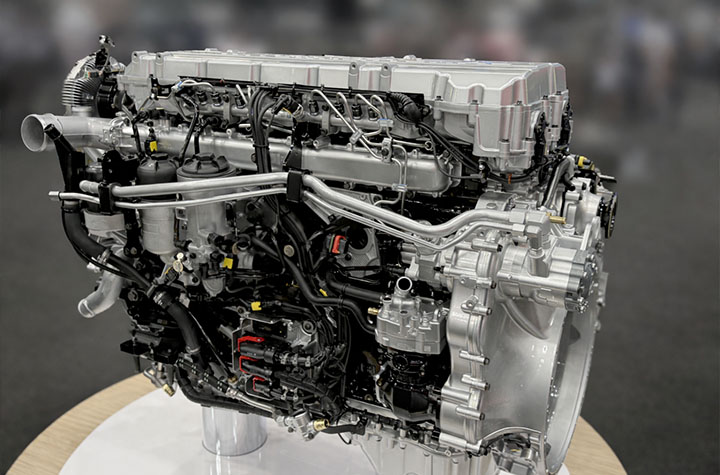
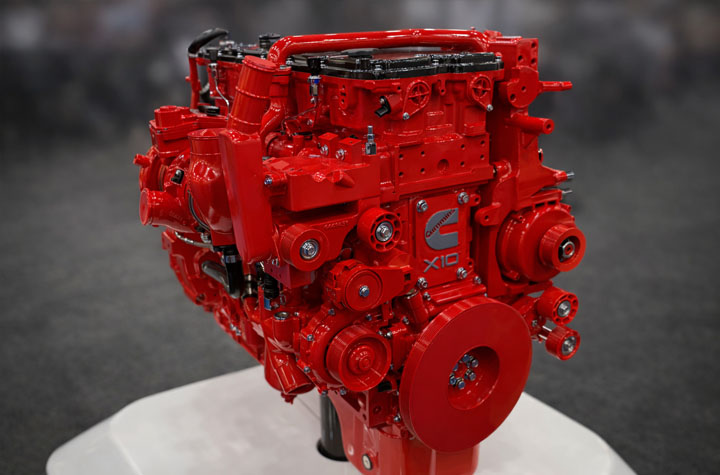
The engine manufacturers did have their 2027-compliant powertrains on display. Here’s a look at what was shown:
A 2027-compliant engine on display at Work Truck Week but still no production chassis to mount it in.
The Cummins X10 engine, one of the platforms being updated for 2027 emissions compliance.
The Aftertreatment Challenge – 2027 Emissions Changes
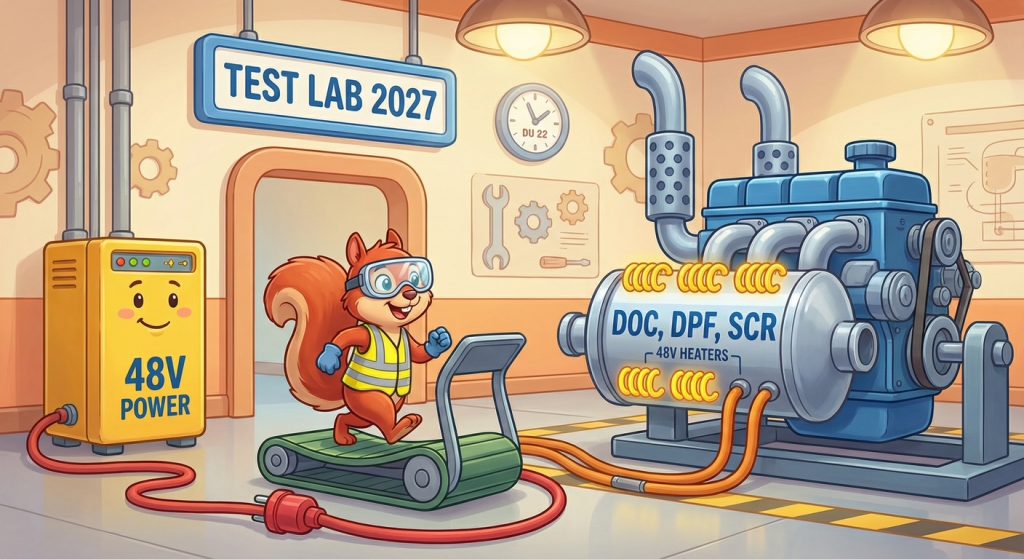
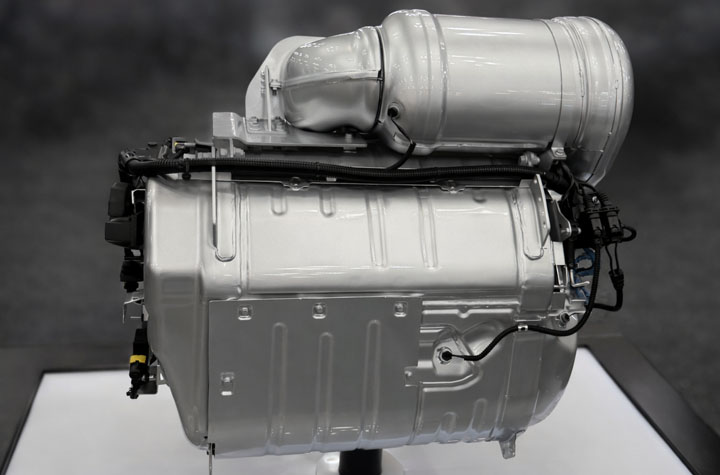
The biggest question for our industry; refuse body and roll-off hoist mounting comes down to the aftertreatment systems. The new DOC, DPF, and SCR units with 48V electric heaters are larger and require different packaging on the chassis frame rails.
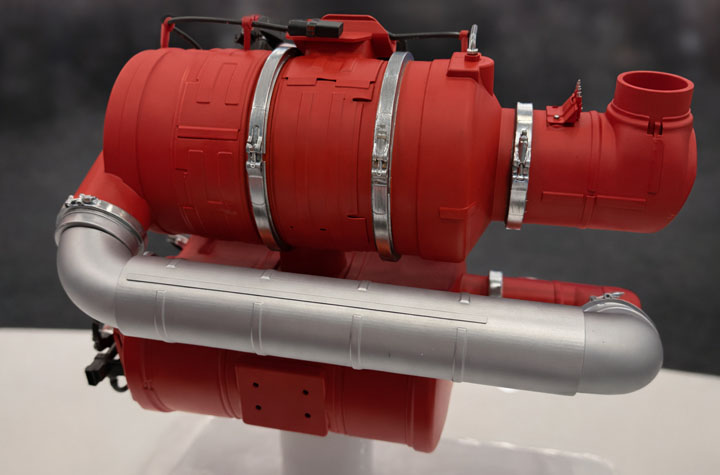
New aftertreatment housing on display, notice the size of this unit compared to current models.
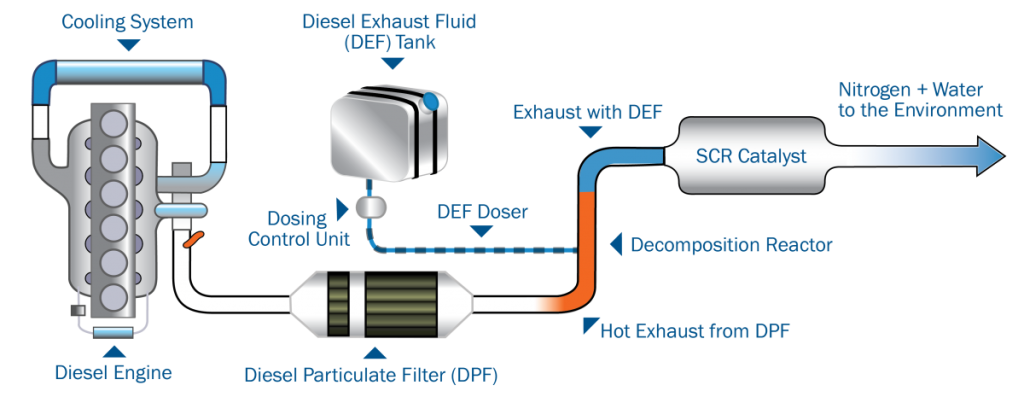
Cummins aftertreatment system for 2027 the exhaust packaging that every chassis manufacturer told me they’re still “fine-tuning” How the New 48V Aftertreatment System Works
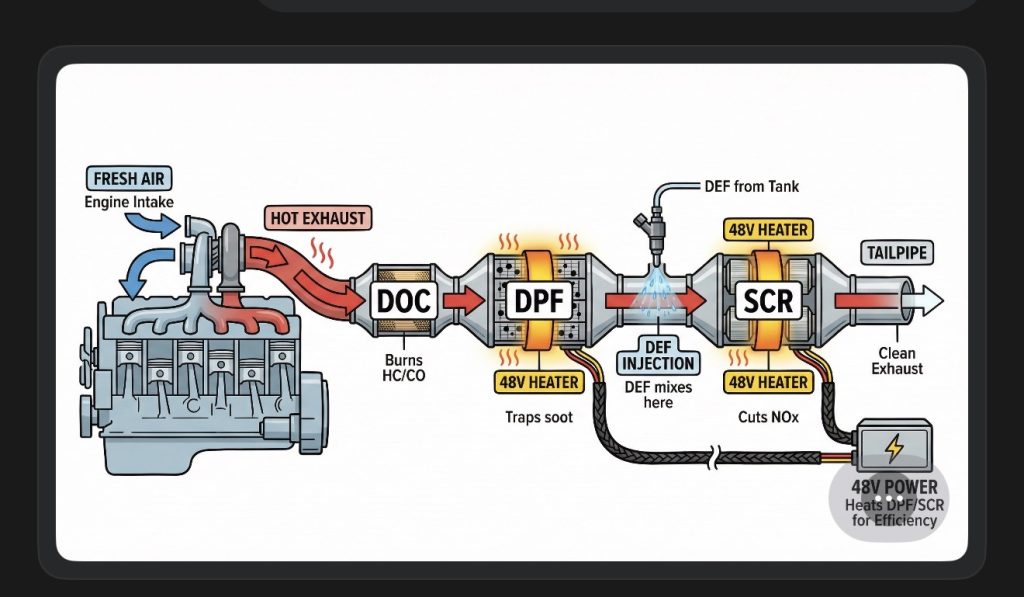
How the New 48V Aftertreatment System Works
This diagram explains the 2027 exhaust flow: DOC → DPF → SCR, all with 48V electric heaters to maintain temperature for emissions control at idle and low loads.
Key Technical Change
DOC → DPF → SCR with 48V Electric Heaters
The 2027 standard introduces electrically heated aftertreatment components to maintain system temperatures during idle and low-load operation. The larger packaging footprint of these units is the primary concern for body upfitters mounting refuse and roll-off equipment on the chassis frame rails.
The Honest Truth – 2027 Emissions Changes
As I sit here on this plane headed home, I ask myself: what did I actually find out on this trip? And why do I feel sick to my stomach? No clear explanation other than everyone trying to sell me on the idea that it’s all under control.
I’m a realist. We know it’s coming, and we know it will not be easy. We can’t pretend it’s all okay.
Next year, if and when the new truck chassis have issues or are delayed or require additional modifications to mount refuse bodies and handle computer programming changes will we be ready? Will we be able to educate our friends, partners, technicians, and the general public with a clearer plan? And in my own business, how do we plan to face these challenges?
I’m sorry to say this is a very difficult task. We have no better idea today than before I landed in Indy on Monday night. I’m writing this to let you know: we are still trying to figure it out. And we will try to keep you informed as we keep pressing forward.
Richard Kemner – RDK Truck Sales
Stay tuned for updates as we learn more about the 2027 emissions transition.
By Richard Kemner, Founder • RDK Truck Sales • Tampa, FL • 40+ Years in the Refuse Industry Dealing with Hydraulic System Maintenance Issues.
✅ SPRING HYDRAULIC CHECKLIST
☐ Pull and inspect hydraulic fluid sample ☐ Change all hydraulic filters (return line, suction, in-line) ☐ Inspect every hose for cracks, bulging, and chafe marks ☐ Check all fittings for leaks ☐ Inspect cylinder rods for scoring and pitting ☐ Look for weeping seals on all cylinders ☐ Test full system operation under load ☐ Listen for pump noise, cavitation, or whine ☐ Verify reservoir fluid level after full cycle ☐ Check breather cap on reservoir for blockage
Winter is hard on garbage trucks. If you run a fleet anywhere that gets real cold, you already know that. But what a lot of operators don’t think about is what happens when the weather changes. That transition from cold to warm is where a lot of problems show up, especially in your hydraulic systems. I’ve been in the refuse business since 1983. Started riding routes at five in the morning just to learn. Over 40 years later, I’m still learning. But one thing I can tell you with absolute confidence is this: your hydraulics are the heartbeat of a refuse truck. If they go down, you go down. And spring is when they like to remind you of that.
Why Winter Beats Up Your Hydraulics
Cold weather thickens hydraulic fluid. When temperatures drop below freezing, your fluid viscosity changes dramatically. That means your pumps are working harder, your cylinders are moving slower, and every seal in the system is under more stress than it was designed for. The rubber in your hoses and seals contracts and gets brittle. Metal components expand and contract with temperature swings. All winter long, your hydraulic system has been taking a beating even if everything looked fine from the cab.
Here’s what we’ve seen over the years: the trucks that have the most spring breakdowns are the ones that nobody looked at during winter. They just kept running them. And now, as temperatures rise, all those cold-weather microdamage starts showing up as real problems.
Hydraulic Fluid: Check It, Change It, Get It Right
This is step one and it’s the most important. Pull a fluid sample. Look at the color. Fresh hydraulic fluid is a clear amber. If yours looks dark, milky, or has visible particles in it, you’ve got contamination. Milky fluid almost always means moisture got in, and that’s a killer for pumps and valves. Even if your fluid looks okay, consider when it was last changed. Most manufacturers recommend a full hydraulic fluid change every 2,000 to 4,000 operating hours depending on the application and the conditions you’re running in. If you ran hard all winter and you’re anywhere near that interval, spring is the time to do it. One thing we tell every customer: don’t mix fluid types. If your system calls for AW-46, use AW-46. If it calls for AW-68, use AW-68. Mixing viscosities or brands can cause foaming, overheating, and accelerated wear. When in doubt, check your operator’s manual or give your body manufacturer a call.
⚠ ️ RDK Pro Tip: If you see foam on top of the fluid when you open the reservoir, you either have an air leak on the suction side or moisture contamination. Don’t ignore it. Both will destroy your pump over time.
Hoses and Fittings: Look for the Warning Signs
Walk around every truck in your fleet with a flashlight and look at every hydraulic hose you can see. You’re looking for cracking on the outer cover, bulging anywhere along the length, wet spots or oil film around fittings, and any hose that looks like it’s been rubbing against the frame or body. Winter cold makes rubber brittle. Spring warmth makes it expand. That cycle is exactly what causes hoses to fail. A hose that survived all winter can blow on the first warm day because the rubber finally gave out after months of contracting and expanding. Pay special attention to hoses near heat sources like the exhaust manifold and engine. Also check any hoses that route through tight spaces where they might rub. Chafing is one of the most common causes of hydraulic hose failure on refuse trucks, and it’s almost always preventable with proper routing and clamps. At RDK we’ve seen hoses blow on route and dump 40 gallons of hydraulic fluid on a residential street. That’s an environmental issue, a safety issue, and a very expensive tow. A ten-minute visual inspection can prevent all of that.
Cylinders and Seals: Where the Money Is
Your packer cylinders, tailgate cylinders, and body lift cylinders do the heavy lifting every single day. After a hard winter, check every cylinder for rod scoring, pitting, and any signs of oil weeping past the seals. Even a small drip means the seal is compromised, and it’s only going to get worse as temperatures rise and the system heats up under load. Seal replacement is relatively inexpensive if you catch it early. A failed cylinder because you let it go is not. We’ve seen packer cylinders lock up mid-cycle because a seal blew out and all the pressure was lost. That’s a truck off route and a crew standing around waiting for a service call.
Filters: The Cheapest Insurance You Can Buy
A key step in hydraulic system maintenance is changing your hydraulic filters. Every single one. Return line filters, suction filters, and any in-line filters your system has. Coming out of winter, those filters have been catching all the contaminants that cold weather and condensation created. A clogged filter means your pump is working against restriction, which means heat, which means accelerated wear on every component downstream. This is one of the simplest and cheapest maintenance items you can do, and it’s one of the most commonly skipped. At RDK we stock filters for every body and chassis we sell. There’s no reason to skip this step.
Test the System Under Load
After you’ve checked the fluid, inspected the hoses, looked at the cylinders, and changed the filters, run the system through a full cycle under load. Watch for slow operation, jerky movements, unusual noise, and any vibration that wasn’t there before. Cycle the packer. Cycle the tailgate. Operate the body lift if applicable. Do it multiple times and pay attention.
A system that works fine with no load but struggles under load is telling you something. Usually it’s a pump that’s starting to wear internally, a relief valve that needs adjustment, or a cylinder that’s bypassing internally even though it’s not leaking externally yet.
This Is Blog 1 of 3 in Our Spring Maintenance Series
Blog 1: Hydraulic System Maintenance: Getting Your Fleet Ready for Spring
Blog 2: Exhaust System & Body Maintenance Preparing for Spring Rain and Wet Weather
Blog 3: DOT Inspection & Chassis Readiness – A Friendly Reminder That Could Save Your Fleet
Subscribe to our email list or follow us online so you don’t miss the rest of the series. And as always, if you have questions or want to talk shop, give us a call.
Let’s Talk Trash & Hydraulic System Maintenance
After 40-plus years in this business, I can tell you one thing for sure: I’m still learning. Every fleet we work with teaches us something new. Every season brings a new challenge. That’s what keeps this industry exciting. If you’ve got a trick that works for your fleet, a question about something we covered here, or you just want to talk trucks, we’d love to hear from you. Drop us a line, give us a call, or stop by the shop in Tampa. At RDK, our customers aren’t just customers. They’re family.
“We Service What We Sell”
Disclaimer: The information in this hydraulic system maintenance blog is based on over 40 years of hands-on experience in the refuse industry. It is intended for general informational purposes only. Every fleet, every route, and every truck is different. We strongly encourage you to conduct your own due diligence, consult with qualified technicians, and follow your manufacturer’s specific maintenance guidelines when making equipment servicing and purchasing decisions. If you have questions or want to talk shop, give us a call. We’re always learning and we welcome your feedback.
When the World Shakes, We Keep Moving – Standing Strong
The news out of Iran these past few days add yet another layer of uncertainty to a world that already feels unsteady. The headlines grow more uncomfortable, and it can seem like the future is slipping further out of focus. Yet here we are. Every morning, we still unlock doors, start engines, load trucks, answer phones, and take care of customers. We keep our commitments. We show up for our teams and our families. The world may shake, but the work still needs doing, and we do it. At the same time, we can’t ignore what’s happening here at home. As a nation, we often seem divided quick to turn every global event into fuel for one agenda or another. Red, blue, left, right. But on days like this, those labels feel small. How about we stand as one today? There are moments in history when the most important thing we can say is simply “us.” We have survived wars, recessions, terrorist attacks, pandemics, and countless personal tragedies. Again and again, we’ve walked through fire and somehow found a way to rebuild. That doesn’t mean the pain isn’t real. Lives have been lost, families have been shattered, and there are people who will carry the weight of this day for the rest of their lives. We can’t and shouldn’t look away from that. Sorrow and compassion are part of what make us human. Still, history teaches a hard but important truth: every period of crisis also brings change, and with change comes opportunity. New ways of working, new partnerships, new technologies, and new paths forward are often born out of the very moments that scare us the most. Adversity has a way of revealing strengths we didn’t know we had. Keep standing strong together as one people under one flag.
The Storm and the Sun
Think about a storm. When it rolls in, it brings rain, wind, and darkness. The sky turns heavy and gray, and for a while it can feel like it will never clear. But storms don’t last forever. The clouds break. The sun comes out. The sky turns clear blue again. The flowers, which looked beaten down, start to bloom even brighter. That’s a metaphor for how we choose to see the “rain” in our own lives and in our world. Is it just sad darkness or is it also a chance to grow? I choose to see it as a pattern: challenge, struggle, renewal, growth. The rain may be uncomfortable, even painful, but it also feeds the roots. It prepares the ground for something new.
Moving Forward Together – Standing Strong
Here at RDK Truck Sales, we will continue to do what we’ve always done: show up, serve our customers, support our partners, and take care of our people. We stand strong not because we know exactly how things will turn out, but because we know who we are when things get hard. We adapt. We adjust. We learn. We hold two truths at once: a genuine grief for those who are hurting, and a stubborn belief that brighter days are still ahead. Every storm brings darkness, but it also makes the sunlight that follows feel even more powerful. Brighter days are to come. The sky will clear, the flowers will bloom, and if we choose to see the bigger picture, we’ll find that even the hardest rain left something valuable behind.
From all of us at RDK Truck Sales, Standing Strong
Richard Kemner Founder RDK Truck Sales Tampa, Florida
What the 2026 Tariff Ruling Means & Why We’re Going to Be Just Fine.
Dear Friends, Partners, Vendors, Suppliers, and Fellow Americans
I hope this message finds you well and encouraged today. Let’s address these tariffs and their impacts.
I have been receiving the same question over and over from customers, partners, and friends across the industry, so I decided to sit down and write this out for everyone who has been asking or wondering:
“Richard, what is the deal with these tariffs?”
Before I dive in, I want to say something important right up front.
I am not writing this as a Republican or a Democrat. I am not red. I am not blue. I am Red, White, and Blue. My only view is what is best for this country – its workers, its families, and its future. I ask that you read this in that same spirit.
Now let’s talk about what is actually happening in plain, simple language.
FIRST, WHY WERE TARIFFS PUT IN PLACE?
For decades, America has watched factories close, good-paying jobs move overseas, and foreign-made goods flood our markets while American workers paid the price. The tariffs put in place over the past year were designed to address exactly that.
The goal was straightforward and something most Americans can appreciate regardless of where they stand politically, stop sending our money out of the country, bring manufacturing jobs back home, and rebuild American industry from the ground up.
The message to the world was clear: if you want to sell in America, there is a cost to that. Put American workers first. Keep American dollars working for American families. Whatever your political views, that is a goal worth understanding and worth respecting.
WHAT DID THE SUPREME COURT JUST DECIDE ON TARIFFS?
On February 20th, 2026, the United States Supreme Court ruled that most of those tariffs were illegal.
Now here is the important part and this gets lost in all the noise. The court did not say that protecting America is wrong. It did not say that keeping jobs here is wrong. It said that the specific law the President used to impose these tariffs was not the right legal tool for the job. That is a critical distinction.
Here is where things stand today with the tariffs:
NO LONGER IN EFFECT: The tariffs on Canada, Mexico, China and the sweeping “Liberation Day” tariffs that applied to imports from nearly every country in the world.
STILL FULLY IN PLACE: Tariffs on steel, aluminum, foreign-made cars and aircraft, and several other specific products. These were established under different laws and the court did not touch them.
ALREADY MOVING FORWARD: Within days of the ruling, the Administration put a new 15% global tariff in place under a different legal framework. The mission to protect American jobs and keep American dollars at home has not stopped it is simply being rebuilt on firmer legal ground.
The bottom line is this, change is still coming with tariffs and some uncertainty will be with us for a while longer. Plan for continued shifts in the months ahead rather than expecting a sudden clean resolution overnight.
THERE IS NO MAGIC FIX TO THE TARIFFS SITUATION AND THAT IS OKAY TO SAY OUT LOUD
I know many of you are feeling the pressure right now. Businesses being squeezed. Decisions being put on hold. Vendors and suppliers trying to navigate costs that seem to change week to week. If you are waiting for someone to tell you everything will be perfectly fine by Monday morning I am not going to do that to you, because I respect you too much to be anything less than completely honest.
There is no magic fix. This is going to take time to work itself out. The road to a stronger, more self-sufficient America was never going to be without cost or without challenge. And the very worst thing we can do right now is pretend otherwise because masking the challenge never makes it go away. Facing it honestly is what moves us forward.
But here is what I know with absolute certainty, we have been here before.
WE HAVE ALWAYS FOUND OUR WAY THROUGH
Think about everything this great nation has faced just in recent memory alone.
We lived through the financial crisis. We lived through periods of deep political division that tested the very fabric of how we see one another. And then came COVID-19 something none of us had a playbook for. Businesses closed overnight, supply chains fell apart, vendors and suppliers scrambled just to survive. Families lost people they loved dearly. The fear and confusion were unlike anything most of us had ever faced in our lifetimes.
And yet, here we are.
We did not just survive it. We came through it together. Neighbors helped neighbors. Partners and suppliers found creative ways to keep each other going. Businesses found new ways to serve their customers. Families held on to each other when nothing made sense. Everyday Americans did what everyday Americans have always done throughout history they showed up, they adapted, and they kept moving forward.
This tariff situation, as frustrating and complex as it is, is simply another chapter in the long and remarkable story of a nation that has never once stayed down when knocked off balance.
AMERICANS FIRST. FAMILY ALWAYS.
Before any of us are business owners, competitors, Republicans, or Democrats we are Americans first. And more than that we are family.
The vision of keeping American money in America, of bringing good jobs back to American workers, of rebuilding industries that support families and communities across this country, that is a vision worth fighting for. We may disagree on the methods. We may hit roadblocks along the way. But the desire for a stronger, more self-sufficient America is something we can all stand behind together.
The best thing we can do right now is not sit and wait for Washington to hand us the answers. It is to take care of each other. Check on your vendors and suppliers. Be straight with your customers and partners. Reach out to the everyday American in your circle who is struggling and remind them they are not alone. You do not need to have all the answers, just be a source of strength and encouragement for someone who needs it today.
And I say this with everything I have, God will see us through this. He always has and He always will. We may not be able to see the full road ahead right now and that is perfectly okay. Faith has never required a clear view of what is coming. It only asks that we keep walking forward with trust in Him and with one another.
THE BOTTOM LINE ON TARIFFS
Tariff policy will keep evolving in the weeks and months ahead. Costs will shift. New rules will come. Some will stick and some will not. The important thing is to stay focused, stay flexible, and stay firmly connected to the people around you, your partners, your vendors, your suppliers, your customers, and your family.
The people and businesses that come through this strongest will not be the ones who waited for perfect conditions. They will be the ones who encouraged instead of complained, who adapted instead of froze, and who never stopped believing that the best days for this country are still ahead of us.
Because they are.
We are and we will always be the greatest country in the world.
Thank you for taking the time to read this message. I genuinely hope it brought some clarity and even more so some real encouragement today. As always, my door is open. If you ever want to talk through how any of this affects your business or your operation, please do not hesitate to reach out. I am always happy to help in any way I can. With deep respect, sincere gratitude, and unwavering belief in this great nation and its people.
5 Roll-off Truck Maintenance Mistakes That Kill Truck Longevity
And the Simple Habits That Turn Your Truck Into a Workhorse for Years
I’ve been around roll-off trucks since 1983. I’ve ridden routes, crawled under frames, and watched thousands of these trucks come through our shop at RDK. And after four decades in this business, I can tell you that the difference between a roll-off truck that gives you ten solid years of service and one that nickel-and-dimes you to death usually comes down to a handful of Roll-off truck maintenance mistakes that operators make over and over again.
None of these are complicated. None of them require expensive tools or specialized training. They’re the basics – the fundamentals that separate operators who get the most out of their equipment from the ones who are always chasing breakdowns.
Here are the five mistakes I see most often, and what you should be doing instead on your Roll-off truck maintenance.
Mistake #1: Not Keeping Your Hydraulic System Clean and Lubricated
If there’s one system on a roll-off truck that will make or break your longevity, it’s the hydraulics. And the key to hydraulic longevity comes down to three things: clean filters, a functioning tank breather, and keeping the hydraulic fluid clean and in proper condition.
Your hydraulic system is the heart of your roll-off operation. Every time that hoist cycles, every time those cylinders extend and retract, that hydraulic fluid is doing the heavy lifting. When the filters are dirty, contaminated fluid circulates through your pumps, valves, and cylinders. That contamination causes internal scoring, seal degradation, and premature wear on components that cost thousands of dollars to replace.
The tank breather is just as critical and even more commonly ignored. The breather allows air to enter and exit the hydraulic tank as fluid levels change during operation. When that breather is clogged or damaged, moisture and debris get pulled into the tank. Moisture in hydraulic fluid causes corrosion from the inside out and degrades the fluid’s performance. I’ve seen operators spend big money chasing hydraulic problems that traced back to nothing more than a neglected breather.
Beyond the filters and breather, the hydraulic fluid itself needs attention. Changing hydraulic fluid on schedule keeps the entire system clean and properly lubricated. Old, degraded fluid loses its ability to protect internal components, and contamination builds up over time no matter how good your filtration is. A clean hydraulic system runs cooler, responds faster, and lasts dramatically longer than one that’s been neglected.
What you should be doing: Change hydraulic filters at regular manufacturer-recommended intervals – and don’t stretch them. Inspect and replace the tank breather on a scheduled basis, not just when you notice a problem. Change your hydraulic fluid according to the manufacturer’s recommendations to keep the system clean and properly lubricated. Keep spare filters and breathers in your parts inventory so there’s never an excuse to skip a change. Staying on top of these basics prevents the expensive pump, valve, and cylinder repairs that come from running a dirty system.
Mistake #2: Skipping the Grease Schedule – Especially the Side Rollers
This one sounds so basic it almost feels embarrassing to write about. But I’m writing about it because I see it constantly – from one-truck operators all the way up to mid-size fleets. Greasing gets skipped, delayed, or done inconsistently, and the damage is cumulative.
A roll-off truck has dozens of grease points – pivot pins, sheave bearings, hoist pins, tailgate hinges, guide rollers, and side rollers, just to name the obvious ones. Every one of those points is metal-on-metal contact under heavy load and repetitive stress. Without a consistent film of grease, you get accelerated wear, increased friction, heat buildup, and eventually component failure.
I want to call special attention to the side rollers, because this is one of the most misunderstood components on a roll-off truck. A lot of operators think the container rides primarily on the rails. It doesn’t. The roll-off box rides the side rollers more than it rides the rail. Those rollers are what guide the container on and off the truck smoothly and keep it tracking straight. When side rollers aren’t being greased regularly, they seize up. A frozen roller is no longer rolling – it’s just a steel post that the container is grinding against. That creates enormous additional friction and drag on the entire hoist system, and the cable is the component that absorbs all of that extra stress.
Frozen side rollers are one of the leading causes of premature cable wear and cable failure that operators never connect to the root cause. They’re replacing cables and blaming the cable, when the real problem is a seized roller that nobody greased. Side rollers need to be greased on schedule and inspected regularly. When a roller is worn, seized, or damaged, replace it immediately – there’s no excuse for running frozen rollers.
What you should be doing: Establish a written grease schedule and stick to it. Daily is ideal for high-cycle operations. At a minimum, grease all points weekly and document it – and make sure the side rollers are on that list every single time. Spin each roller by hand during your inspection. If it doesn’t spin freely, it needs grease or replacement. Make greasing part of the driver’s pre-trip routine or assign it to a dedicated maintenance person. A grease gun and fifteen minutes of attention is one of the cheapest investments you can make in the life of your truck. A regular grease schedule, done consistently, will turn your roll-off truck into a true workhorse that performs year after year.
Mistake #3: Failing to Retorque Your PTO Mounting Bolts
This is one of the most overlooked maintenance items in the refuse industry, and it applies to every transmission type – Allison automatics, manual transmissions, all of them. Your Power Take-Off is bolted directly to the transmission and it absorbs enormous torsional vibration every time it operates. Those mounting bolts loosen over time. It’s not a question of if – it’s a question of when.
PTOs on refuse trucks take a tremendous amount of torque. Think about what that unit is doing: it’s driving your hydraulic pump, powering the hoist system, and cycling under heavy loads all day long. The torsional vibrations from today’s high-torque, low-RPM diesel engines make this even worse. Those vibrations work on the mounting bolts constantly, and if you’re not retorquing them on a regular basis, you’re setting yourself up for a transmission oil leak – or worse, PTO or transmission damage.
Don’t wait until you see transmission oil on the ground to check your PTO bolts. By the time you see a leak, the bolts have been loose long enough to cause damage to the gasket surface, the PTO housing, or the transmission case itself. That’s a repair bill that dwarfs the cost of a simple retorque.
OEM RECOMMENDATION – Allison Transmission / Chelsea (Parker Hannifin)
Chelsea Technical Bulletin PTO-TEC-137 (Parker Hannifin, Chelsea Products Division) specifically addresses PTO maintenance on Allison World transmissions and states:
“Monthly: Inspect for possible leaks and tighten all air, hydraulic and mounting hardware, if necessary. Torque all bolts, nuts, etc. to Chelsea specifications.”
The same bulletin notes that Chelsea engineering increased the mounting bolt torque specification for all 10-bolt series PTOs on Allison transmissions from the previous 30–35 lb-ft to 40–50 lb-ft (54–68 Nm) specifically due to the increasing vibrations in today’s high-torque, low-RPM diesel engines.
The bulletin further warns: “Due to the normal and sometime severe torsional vibrations that Power Take-Off units experience, operators should follow a set maintenance schedule for inspections. Failure to service loose bolts or Power Take-Off leaks could result in potential auxiliary Power Take-Off or transmission damage.”
Source: Parker Hannifin, Chelsea Products Division, Technical Bulletin PTO-TEC-137. For complete specifications, visit allisontransmission.com or contact your Allison dealer for the latest service publications.Read the bulletin here
What you should be doing: Retorque your PTO mounting bolts monthly – every 30 days, no exceptions. This applies to all transmissions, but it is especially critical on Allison automatics where the PTO is absorbing significant torsional loads. Use the correct torque specification for your PTO series and check with your PTO manufacturer if you’re unsure of the current spec. While you’re under there, inspect for any signs of oil seepage around the PTO gasket and mounting surface. Also ensure that direct-mount pump splines are properly lubricated with the recommended anti-fretting grease, as torsional vibrations cause fretting corrosion that wears out splines prematurely. This is a fifteen-minute job that can save you thousands in transmission and PTO repairs. Don’t wait to see a transmission oil leak – by then, the damage is already done.
Mistake #4: Neglecting the Reeving Cylinder Sheaves – The #1 Cause of Repeat Cable Failures
Your hoist cable is the single component holding your container in place during loading, transport, and unloading. There is no margin for failure here. A cable that snaps under load is a catastrophic event – it can destroy the container, damage the truck, injure the driver, and put bystanders at risk.
I regularly see operators running cables with visible fraying, kinking, or bird-caging. The mentality is always the same: “It’s still holding, so it’s fine.” That’s not maintenance. That’s gambling.
But here’s what most operators miss, and this is critical: if you’re breaking cables repeatedly, the cable itself is usually not the problem. The real culprit is almost always the sheaves – and the main sheaves on the reeving cylinders are the most commonly neglected components on a roll-off truck. These are the sheaves that carry the most cable load, operate under the highest stress, and cycle the most during every hoist operation. And they are the ones that almost nobody maintains.
When those reeving cylinder sheaves wear down, you’re no longer running cable over a smooth, properly radiused groove. You’re running steel cable over worn, flattened, or grooved steel – steel on steel. That dramatically increases the friction, heat, and stress on the cable every time the hoist cycles. The cable is being abraded and fatigued at an accelerated rate, and no matter how many new cables you put on, they’ll keep failing prematurely until you address the sheave condition.
I’ve seen operators go through cable after cable, spending hundreds of dollars each time on replacement and downtime, when a sheave inspection and replacement would have solved the problem permanently. Worn sheaves don’t just wear out cables faster – they put uneven stress on the cable that causes weak points, fraying, and sudden failure under load. That’s a safety issue, not just a maintenance issue.
What you should be doing: Inspect cables at every pre-trip. Look for fraying, kinking, corrosion, and bird-caging. Replace cables based on manufacturer guidelines and inspection findings – not based on whether they’ve failed yet. But just as importantly, make the reeving cylinder sheaves a priority in your maintenance routine. Inspect them regularly for wear, grooving, flat spots, and proper rotation. If a sheave isn’t spinning freely or the groove profile has worn down, replace it. If you’re going through cables faster than you should be, stop blaming the cable and look at the reeving cylinder sheaves first. That’s where the problem almost always lives. Addressing the root cause saves you money, reduces downtime, and eliminates a serious safety hazard.
Mistake #5: Ignoring Rail Wear Until It’s a Problem
The rails on a roll-off truck take a beating every single day. Containers slide on and off those rails thousands of times over the life of the truck, and every load puts stress on the rail surface and the mounting points. Rail wear is gradual, which is exactly why it gets ignored – until the container starts tracking poorly, loading unevenly, or damaging the frame.
Worn rails don’t just affect the truck. They damage your containers, too. When containers don’t seat properly, you get uneven loading, increased stress on the hoist system, and safety concerns during transport. I’ve seen worn rails cause container damage that cost more to repair than addressing the rail wear would have in the first place.
What you should be doing: Inspect rails visually on a regular basis – look for gouging, uneven wear patterns, and thinning. Measure rail thickness periodically and compare it against manufacturer specs. Plan for rail replacement or buildup before the wear reaches the point where it’s affecting operation. Addressing rail wear proactively is far cheaper than dealing with the cascade of problems it creates when you let it go.
Bonus Mistake: Treating Frame Stress Cracks as Cosmetic
Roll-off trucks work under enormous stress. The combination of heavy loads, repetitive hoist cycling, road vibration, and off-road conditions puts constant strain on the frame and subframe. Stress cracks are inevitable over time – but how you respond to them determines whether they’re a minor Roll-off truck maintenance item or a major structural failure.
Too many operators treat small frame cracks as cosmetic issues. They see a hairline crack and decide to deal with it later. But frame cracks propagate. A small crack today becomes a structural compromise next month. I’ve seen trucks come into our shop with frame damage that started as a simple stress crack that could have been repaired for a few hundred dollars but turned into a multi-thousand-dollar rebuild because it was ignored.What you should be doing: Include frame and subframe inspection in your regular maintenance routine. Look for cracks at high-stress points: hoist mounting areas, rail attachment points, cross-member joints, and anywhere you see paint cracking or rust bubbling. When you find a crack, address it immediately with proper welding repair by a qualified technician. Small repairs now prevent catastrophic failures later.
Why RDK Built a Better Hoist
Every Roll-off truck maintenance issue in this article – from hydraulic system cleanliness, to reeving cylinder sheave access, to cable longevity, to frame stress cracks – informed the design of the RDK-influenced Pac-Mac roll-off hoist. After four decades of watching these problems repeat themselves across every hoist brand on the market, I partnered with Pac-Mac (Hol-Mac Corporation) to start with a blank slate and build the hoist I always wished existed.
The result addresses these exact maintenance challenges by design. Crossmembers are moved back five inches so sheave blocks can be removed without cutting reeving cages or pulling reeving cylinders – because we know those main reeving cylinder sheaves are the most neglected components on a roll-off truck, and if they’re hard to access, they won’t get maintained. The 5-spool integrated valve body reduces hoses, fittings, and leak points. The hydraulic tank is mounted on the gantry assembly, shortening hydraulic lines and keeping the system cleaner. Heavier gauge domestic steel in the main frame means fewer stress cracks over the life of the truck. Every feature on this hoist exists because we saw the problem in the field first.
To read the full story behind the RDK-influenced Pac-Mac hoist design – including the innovations, engineering decisions, and 40+ years of field experience that went into it – see our companion article: “Why the RDK-Style Pac-Mac Roll-off Hoist?” (Coming Soon).
The Common Thread: Discipline Over Dollars
If you look at these mistakes, you’ll notice something: none of them are expensive to prevent. Clean hydraulic fluid, filters, tank breathers, grease, side rollers, PTO retorques, reeving cylinder sheave inspections, and crack repairs – these are all basic, affordable maintenance tasks. The expense comes when you skip them.
A roll-off truck that gets consistent attention to these fundamentals becomes a real workhorse – the kind of truck that runs reliably day after day, year after year, and still has strong resale value when you’re ready to cycle it out of your fleet. The trucks that get neglected become money pits that drain your operating budget and put your business at risk.
At RDK Truck Sales, we’ve built our reputation on the philosophy that “We service what we sell.” That means when you buy a truck from us, you get priority access to our shop, our parts inventory of over $2 million, and our team’s decades of hands-on experience keeping roll-off trucks on the road. But even the best service partner in the world can’t help you if the basics aren’t being done between visits. Take care of the fundamentals. Build the discipline into your operation. Your trucks – and your bottom line – will thank you for it.
Richard Kemner Founder, RDK Truck Sales Tampa, FL – Serving the Refuse Industry Since 1997 “We Service What We Sell”
This article is provided for informational purposes only. Maintenance intervals, torque specifications, and procedures may vary by manufacturer, model, and operating conditions. The OEM recommendations referenced in this article are sourced from publicly available technical bulletins and are provided for educational purposes. As with any equipment maintenance decision, we encourage readers to conduct their own due diligence, consult current manufacturer documentation directly, and work with qualified service professionals. Always follow applicable safety regulations and the most current manufacturer guidelines for your specific equipment.
All Dealers That Sell Roll-off Trucks Are NOT the Same: Here’s What You Need to Know Before You Buy
After 40+ years and thousands of roll-off trucks built, I can tell you this: one size does NOT fit all.
At RDK, we sell all the major chassis and body brands. We support most manufacturers for parts and service. But we will always tell you the truth: just because we sell everything doesn’t mean everything is right for you.
Here’s What Nobody Else Will Tell You About: Roll-off Trucks
Multi-application dealers stock chassis that work across dump trucks, boom trucks, flatbeds, and roll-offs. Convenient for them. Costly for you. Roll-off applications demand purpose-built specs not adapted inventory.
Quick-mount shops piece together kits with whatever parts are available that week. Two years later, when you need service? Good luck finding consistent components or matching parts.
Some manufacturers have been sold so many times they’re more interested in profit than performance. They want to move iron today not build trucks that run strong a decade from now.
RDK Gives You More Choices: Roll-off Trucks
We design and build our own hoists. Our chassis specs are written for Roll-off applications. We operate our own roll-off business, rental fleet, and leasing company so we spec trucks we’d want to own, operate, and maintain ourselves.
WE SERVICE WHAT WE SELL
✓ Purpose-built chassis specs for Roll-off Truck durability
✓ Consistent builds same components every time
✓ $2M+ parts inventory for fast turnaround
✓ Factory-trained technicians who know your truck
✓ We stand as a partner with you not just a vendor
RDK Buying Options Your Way: Roll-off Trucks
We give you the flexibility to acquire equipment the way that works best for your business:
Purchase: Buy new or quality pre-owned Roll-off trucks spec’d for your operation. 8,400+ sold and counting.
Lease: Flexible lease terms that preserve capital and keep your fleet current. Predictable monthly costs with options at term end.
Rent: Short term rental fleet available when you need backup units, seasonal capacity, or want to try before you buy.
Parts: $2M+ inventory for most major brands. Same-day shipping on in-stock items. We know what fits because we use it ourselves.
Service: Full-service shop and mobile field service. Warranty work, repairs, rebuilds, and preventative maintenance from technicians who specialize in refuse equipment.
Bodies & Hoists: Pac-Mac, Galbreath, Gal-fab, and our own RDK-designed hoists built for durability and serviceability
I started in this business in 1983, riding garbage routes at 5 AM to learn from the ground up. I founded RDK in 1997 to be the advisor I wished I’d had. That hasn’t changed. We’re not just selling trucks—we’re building partnerships.
After more than four decades in this industry starting back in 1983 when I was riding routes at 5 AM just to learn the business, I’ve seen plenty of trucks sidelined by cold weather problems that could have been prevented. Hydraulic issues top that list every single winter. This is what 40 years of experience has taught me about cold weather hydraulic maintenance.
Why Cold Weather Hits Hydraulics So Hard
Here’s what I tell every customer who calls in December wondering why their packer is acting sluggish: hydraulic fluid doesn’t like cold any more than you do.
When temperatures drop, that fluid thickens up considerably. I’ve watched operators jump in a truck on a 25-degree morning, fire it up, and immediately start cycling the packer at full speed. That’s asking for trouble. Thick, cold fluid can’t flow through lines and valves the way it needs to. The pump strains to pull fluid that moves like molasses. Pressures spike. Seals that were fine yesterday started weeping because they’re stiff and can’t flex properly.
I learned this lesson the hard way years ago, and I’ve seen the repair bills to prove it, blown hoses, damaged pumps, cylinders that needed rebuilding. All because someone was in a hurry on a cold morning.
What Actually Works
Give Your Truck Time to Wake Up
I know routes are tight and every minute counts. But five to ten minutes of warm-up, followed by running the packer through a few slow, easy cycles before you head out, saves hours of downtime later. Let that fluid circulate and warm up gradually. Your hydraulic system will thank you.
Check Your Fluid Rating
Not all hydraulic fluid handles cold the same way. If you’re running standard fluid and operating in temperatures that regularly dip below freezing, talk to your parts department about a multi-viscosity fluid designed for wider temperature swings. It’s a simple change that makes a real difference.
Watch Your Seals and Hoses
Cold makes rubber stiff and brittle. That small seep that you’ve been ignoring. It’s about to become a real leak when temperatures drop and that hose or seal can’t flex anymore. Winter is when marginal components fail. Walk around your truck and look, really look, for any signs of fluid where it shouldn’t be.
Listen to Your Equipment
After enough years, you develop an ear for what sounds right and what doesn’t. A pump working too hard has a different tone. Cylinders that are starving for fluid don’t move smoothly. If something sounds off on a cold morning, don’t push it. Let it warm up more or get it checked out.
The Real Cost of Skipping This
I’ve sold over 8,400 trucks through RDK since 1997, and I’ve had countless conversations with operators about what went wrong. The pattern is always the same: cold snap hits, someone’s running behind, they skip the warm-up, and by noon they’re on the phone needing emergency service.
A blown hydraulic hose on route doesn’t just mean a repair bill. It means a truck sitting on someone’s street leaking fluid. This also means a route that doesn’t get finished and your other trucks and crews are scrambling to cover. One shortcut in the morning turns into a full day’s headache.
Bottom Line – Cold Weather Hydraulic Maintenance
Treat your hydraulic system with a little extra patience when it’s cold outside. The few minutes you invest in proper warm-up and the attention you pay to fluid condition and component wear will keep your trucks running when you need them most.
That’s not just advice I give, it’s how we’ve operated for nearly 30 years at RDK. Take care of the equipment, and it takes care of you.
Have questions about cold weather hydraulic maintenance or need parts for your fleet? Contact RDK Truck Sales– we’ve been keeping refuse trucks running since 1997.
Brutal Cold Incoming: Protect Your Fleet This Weekend!
By Richard Kemner, RDK Truck Sales | January 2026 | Cold Weather Fleet Maintenance
If you’re running routes anywhere from the Midwest to the Northeast and Mid-Atlantic this weekend, you already know what’s coming. We’re looking at temperatures dropping well below freezing—some areas dipping below zero—with ice storms, snow, and freezing sleet making things even more challenging.
After 40+ years in this industry, I’ve seen plenty of cold snaps. But today’s trucks and equipment require a different game plan than they did 20 years ago. Here’s what you need to know to keep your fleet moving.
The DEF Problem: Your Biggest Cold Weather Enemy Diesel Exhaust Fluid freezes at 12°F (-11°C). That’s not “below zero” cold—that’s a regular winter night in half the country this weekend.
What happens when DEF freezes: Your truck goes into derate mode (reduced power). In severe cases, the engine won’t start at all. The DEF tank and lines can crack if completely frozen.
What to do: Keep trucks in heated buildings overnight whenever possible. If outdoor parking is your only option, use DEF tank heaters. Run the engine periodically to keep the system warm. Never add additives to DEF—it voids warranties and damages the system. Keep DEF tanks at least half full; less fluid freezes faster.
DPF and Aftertreatment Systems The Diesel Particulate Filter and SCR systems on modern trucks hate cold weather. Regen cycles take longer, sensors get sluggish, and the whole system works overtime.
Watch for: Extended regen times tying up trucks. Warning lights from cold sensors giving false readings. Blocked regens if trucks are doing short runs and shutting down before completing cycles.
What to do: Let trucks fully complete regen cycles before shutting down—even if it means idling an extra 20 minutes. Don’t ignore warning lights; cold weather amplifies small issues into big problems. If a truck has been sitting in extreme cold, let it idle and warm up before hitting the road.
Hydraulic Systems: Your Packer’s Worst Nightmare This is where I see crews get into real trouble. Hydraulic fluid thickens dramatically in cold weather. What flows like water at 70°F moves like honey at 10°F—and barely moves at all below zero.
The problems you’ll see: Slow or jerky packer operation. Cylinders that won’t fully extend or retract. Increased strain on pumps (leading to premature failure). Seals that crack and start leaking.
What to do: Warm up the hydraulic system before running full cycles—operate the packer slowly through several partial cycles first. Check hydraulic fluid levels; cold weather reveals low fluid faster. Inspect all hoses and fittings for cracks before heading out. Consider switching to a lower-viscosity hydraulic fluid for winter operations if you haven’t already.
Packing Frozen Trash: Physics Works Against You Here’s something newer operators don’t always think about: frozen garbage doesn’t compact like regular garbage. When trash is frozen solid, your packer is essentially trying to crush ice blocks. This puts tremendous strain on the packer, the hydraulics, and the truck’s PTO system.
What to do: Don’t force it—if the packer is struggling, back off. Expect reduced payload; frozen material takes up more space. Run more frequent trips rather than trying to crush frozen loads into one haul. Inspect packer blades and components for damage after running frozen loads.
Quick Pre-Trip Checklist for Extreme Cold Before your drivers head out this weekend:
Inspect batteries – cold weather kills weak batteries; test them now
Look at air dryers and tanks – moisture freezes and locks up brakes
Test all lights – shorter days mean more time running in the dark
Verify tire pressure – cold drops PSI; check and adjust
Confirm heaters work – cab heaters and DEF tank heaters
Check wipers and washer fluid – use winter-rated fluid only
The Bottom Line Modern trucks give us better fuel economy, cleaner emissions, and more power than ever. But they also demand more attention in extreme weather. The crews that take 30 extra minutes to prep their equipment this weekend are the ones who won’t be stuck on the side of the road calling for a tow.
Stay safe out there. If you need parts, service support, or just want to talk through what you’re seeing in the field, give us a call. That’s what we’re here for. RDK Truck Sales has been serving the refuse industry since 1997. We’re an independent dealer representing Battle Motors, Pac-Mac, New Way, Labrie, and all major chassis manufacturers. Sales, service, parts, and leasing—nationwide.
Like our cold weather fleet maintenance blog? Check out some of our other material.
This DPF and DEF system maintenance guide covers best practices, common mistakes, and how to avoid costly repairs.
Brought to you by Richard Kemner | RDK Truck Sales
THE 5 MOST COSTLY MISTAKES
1. Putting diesel fuel in the DEF tank → $8,000 – $15,000 system replacement 2. Using non-dedicated funnels or containers → Permanent catalyst poisoning ($3,000 – $5,000) 3. Using old, heat-damaged, or diluted DEF → Injector failure, crystalline deposits ($1,500 – $3,000) 4. Interrupting DPF regeneration cycles → Excessive soot loading, forced regen, potential DPF damage ($2,000 – $8,000) 5. Ignoring warning lights and fault codes → Small problems become complete system failures
Quick Reference: Do’s and Don’ts
DO THIS
NEVER DO THIS
Use only API-certified DEF
Put any other fluid in DEF tank
Use dedicated blue DEF equipment only
Use funnels/containers that held other fluids
Store DEF in cool location (50-77°F ideal)
Store DEF in direct sunlight or above 86°F
Clean filler area before opening DEF cap
Leave DEF cap off or fill in dusty conditions
Allow DPF regeneration to complete
Shut off engine during active regeneration
Use CK-4 or FA-4 low-ash engine oil
Use high-ash oil (accelerates DPF clogging)
Address warning lights immediately
Ignore fault codes or “wait and see”
Section 1: How to Fill a DEF Tank Properly
⚠ WHAT GOES WRONG:• Cross-contamination: Using equipment that touched fuel or oil introduces contaminants that poison the SCR catalyst permanently • Dirt and debris: Particles enter through dirty fill areas, clogging the DEF filter and pump • Misfueling: Even a small amount of diesel in the DEF tank destroys the entire SCR system
Required: Clean Filling Procedure
Clean the area around the DEF cap with a lint-free cloth before opening
Use only dedicated DEF equipment (blue funnels, containers, nozzles) – never equipment that held other fluids
Verify DEF is API-certified and check the date – don’t use expired product
Fill slowly to prevent splashing – do not overfill
Replace cap immediately after filling – never leave it open
Clean up any spills with water immediately (DEF crystallizes on surfaces)
Equipment Requirements
Containers: Stainless steel or HDPE plastic only – dedicated to DEF
Funnels: Blue color-coded, never used for anything else
Storage: Keep filling equipment covered and clean between uses
Incompatible materials: Copper, brass, zinc, galvanized metal, aluminum, carbon steel – contact with these contaminates DEF
Section 2: How to Store DEF Properly for to Reduce Degradation
⚠ WHAT GOES WRONG:• Heat degradation: DEF stored above 86°F breaks down, forms crystalline deposits in the injector and catalyst • Wrong concentration: DIY mixing or water dilution causes improper NOx conversion, triggering fault codes and derating • Metal contamination: Trace metals from improper containers permanently poison the catalyst – cannot be reversed
DEF Specification Requirements
Only use DEF that is API-certified and meets ISO 22241 standards:
Parameter
Requirement
Urea Concentration
32.5% ± 0.7% (CRITICAL)
Water Quality
Deionized/demineralized only
Metals (Ca, Fe, Cu, Zn)
< 0.5 ppm total
Phosphates
< 0.5 ppm (trace amounts kill catalyst)
Storage Temperature Impact
Temperature
Shelf Life
Action
50-77°F (10-25°C)
24+ months
IDEAL
77-86°F (25-30°C)
~12 months
Acceptable
86-95°F (30-35°C)
~6 months
Use quickly
Above 95°F (35°C)
Rapid breakdown
DO NOT USE
Storage Best Practices
Store indoors in a cool, dry, well-ventilated area away from direct sunlight
Keep containers sealed – ammonia evaporates from exposed DEF
Practice FIFO (First In, First Out) – mark containers with purchase dates
Never mix DEF from different suppliers or batches
Section 3: Proper DPF Maintenance Required
⚠ WHAT GOES WRONG:• Interrupted regeneration: Shutting off the engine during active regen prevents soot burnoff, leading to excessive loading and forced parked regen • Excessive idling: Low exhaust temps produce soot but can’t burn it off – rapid DPF loading • Wrong engine oil: High-ash oils leave incombustible deposits that regeneration cannot remove • Ignored warning lights: Continued operation with high soot loading can cause thermal damage to the DPF substrate
Understanding Regeneration
The DPF collects soot and must periodically burn it off. There are three types of regeneration:
Type
When It Happens
What To Do
Passive
Automatically during highway driving (high exhaust temps)
No action needed – happens naturally
Active
ECM injects extra fuel when passive isn’t enough (light may illuminate)
Keep driving until complete – don’t shut off
Parked/Forced
Required when DPF is severely loaded
Must perform immediately to prevent damage
Operational Best Practices
Allow regeneration to complete: When the DPF indicator shows active regen, maintain steady driving (if safe) until it finishes
Schedule highway time: Vehicles with mostly short-trip, stop-and-go operation need periodic highway driving for passive regen
Minimize idle time: Excessive idling produces soot without the heat to burn it off – use APU when stationary
Check DEF level – top off using clean filling procedures
Monitor dashboard for DPF or DEF warning lights
Allow regeneration cycles to complete – don’t shut off during active regen
Report any unusual exhaust smoke or odors
Weekly (Shop/Fleet Manager)
Verify DEF inventory is properly stored (cool, sealed, in date)
Inspect DEF filling equipment for cleanliness
Review any logged fault codes across fleet
Each PM Service
Check exhaust back pressure readings
Inspect DEF tank cap and seal condition
Inspect DEF lines and connections for crystalline deposits
Check for DEF leaks
Review and document any stored fault codes
Verify correct engine oil is being used (CK-4/FA-4)
Annual
Professional DPF inspection – evaluate cleaning need
DEF system component inspection
NOx sensor testing
Audit DEF storage and handling procedures
Driver/technician refresher training on proper procedures
REMEMBER: THE 3 KEYS TO SYSTEM LONGEVITY
1. QUALITY DEF – API certified, properly stored, never contaminated 2. CLEAN FILLING – Dedicated equipment, clean procedures, every time 3. COMPLETE REGENERATION – Let the DPF do its job, don’t interrupt
Additional Resources
For more information on DEF and DPF system requirements, refer to these official sources: Thank you for reading our DPF and DEF System Maintenance Guide.
Seven 2025 recession indicators are telling the same story. The question isn’t whether we’re in trouble. It’s what we do about it.
Richard Kemner
Founder and CEO, RDK Truck Sales
December 2025
After 42 years in the refuse equipment industry, starting in 1983 when I rode garbage routes at 5 AM to earn meetings with decision makers, I’ve learned to pay attention to economic indicators that don’t make headlines. The data points I’m watching right now tell a consistent story.
None of this is meant to be doom and gloom. It’s meant to be real. And real is what helps us make smart decisions.
So let me tell you what I’m seeing. These are the 2025 recession indicators that paint a very real picture.
• • •
THE FREIGHT RECESSION
If you want to know where the economy is headed, follow the trucks. National freight tonnage is down roughly 7% year over year. More concerning is the duration: we’re now in the longest freight recession in modern history, stretching back to April 2022. Over three years of declining volumes.
Q4 2024 shipments fell 4.7%, marking the tenth consecutive quarterly decline (source). Spot market loads are down approximately 30% compared to last year (source). Carrier bankruptcies have increased by 30% (source), with over 17,500 trucking companies losing their operating authority.
Driver profits have collapsed from roughly $1 per mile to just 3 cents.
When trucks aren’t moving, goods aren’t flowing. When goods aren’t flowing, the economy is contracting.
“Over 70% of all goods in America move by truck. This is the circulatory system of the economy, and it’s showing reduced blood flow.”
This is a clear indicator and is one of the major 2025 recession indicators.
THE CLASS 8 COLLAPSE
This one hits close to home. September 2025 Class 8 retail sales fell 25.6% to just 16,228 units. Class 8 truck orders hit a 16-year low in June 2025. That’s the weakest order activity since 2009.
New truck inventories are approaching all-time highs. Combined net orders for September and October are 32% below year ago levels. Publicly traded fleets ended Q1 2025 with the weakest net income margins since 2010.
Freightliner: 4,738 units, down 39.7% from October 2024
Volvo: YTD lags 24.1% behind 2024 pace
International: Down 33% from October 2024
Peterbilt: Down 27.9% from October 2024
Kenworth: Down 25.8% from October 2024
Mack: YTD sales up 12.2% (the only bright spot)
Used truck prices fell 3.5% month over month in October and are now down 8% year over year. Tariffs are adding approximately $9,000 to $10,000 per Class 8 unit.
When companies stop buying $150,000 trucks, they’re telling you they don’t see growth ahead.
THE BELLWETHERS ARE CUTTING
When the two largest employers in the country start trimming, it means something.
Amazon is cutting approximately 14,000 corporate positions (source). Link Walmart eliminated 1,500 jobs and froze headcount at 2.1 million employees (source). These aren’t struggling companies. They’re the most sophisticated demand forecasters on the planet.
They’re seeing something.
The first 10 months of 2025 saw 1.1 million announced layoffs, 44% higher than the same period in 2024 and the highest level since 2020. Both companies are accelerating automation: over 50% of e-commerce operations and more than 60% of stores are getting automated freight systems.
The jobs being eliminated aren’t coming back. This is structural change, not cyclical adjustment.
THE GARBAGE INDEX
This is my world, and it never lies.
“As Deutsche Bank’s chief international economist Torsten Slok noted in a 2016 CNBC interview, garbage volumes track consumption with remarkable precision.” (Source)
Municipalities across the country are reporting declining waste tonnages. A study in Cedar Rapids found direct correlation between garbage weight and economic activity. Many assumed commercial volumes would rebound after the pandemic. They haven’t. Landfills reported overall tonnage declines.
People are simply consuming less because everything costs more.
“People can lie on surveys. Garbage cans can’t.”
THE HOUSING OVERHANG
Unsold completed new single-family homes hit 121,000 in July 2025. The highest level since July 2009, during the last recession. We haven’t seen this much unsold builder inventory in 16 years.
Housing inventory is back to pre-pandemic 2019 levels, with 33% more homes on the market now than a year ago. New home sales in July 2025 were down 8.1% compared to the previous year. That’s eight consecutive quarters of year over year price declines.
Lennar, one of the nation’s largest builders, is offering buyer incentives totaling 13% of sale price. Up from just 1.5% in Q2 2022. On a $400,000 home, that’s $52,000 in givebacks.
That’s not confidence.
THE LABOR SHIFT
For the first time in over 50 years, the United States is experiencing negative net migration (source). More people are leaving than arriving.
Construction wages are up 8-9% as labor shortages intensify (source). In agriculture, hospitality, and construction, costs are rising and output is falling. Fewer workers mean fewer consumers, fewer renters, fewer car buyers, and less economic activity overall.
It’s a headwind that won’t be resolved quickly.
THE HEALTHCARE SQUEEZE
ACA marketplace premiums are up 26% for 2026. (source) Employer sponsored coverage costs rose 6 to 7% this year. GLP 1 drugs like Ozempic and Wegovy are driving quarterly pharmacy cost increases of 25 to 30%.
For small and mid-sized businesses, healthcare is becoming an existential cost. Every dollar that goes to premiums is a dollar not available for wages, equipment, or expansion.
• • •
RECESSION OR CORRECTION?
So here’s the question everyone’s asking: Is this a recession, or are we watching a long overdue price correction after years of overspending?
I think it’s both. And something more. Here is my thoughts and my 2025 recession indicators.
What we’re experiencing is the hangover from years of unprecedented government spending, near zero interest rates, and stimulus checks that flooded the economy with money that had to go somewhere. It went into inflated asset prices, speculative investments, and consumption patterns that were never sustainable.
Now the bill is coming due.
But it’s not just the money. It’s the uncertainty.
The average American is watching Republicans and Democrats fight like it’s a blood sport while nothing gets solved. Healthcare costs keep climbing. The border remains a mess. Regulations change with every administration. Trade policy swings from tariffs to free trade and back again.
Nobody knows what the rules will be next year, let alone five years from now.
And then there’s the world stage. Russia and Ukraine. China and Taiwan. The Middle East in flames. Foreign governments jockeying for position while the global order that American businesses counted on for decades looks increasingly fragile.
Supply chains that once seemed reliable now feel like a gamble.
“Whether you call it a recession or a correction almost doesn’t matter. What matters is the psychology. And right now, the psychology is defensive.”
Put it all together and what do you get? An American consumer and business owner who’s uneasy. Not panicked, but cautious. Holding back on the big purchase. Delaying the expansion. Keeping cash on hand instead of investing.
That unease shows up in every indicator I’ve outlined above. Freight doesn’t move when people aren’t buying. Trucks don’t sell when fleets aren’t confident. Houses sit unsold when families aren’t sure about tomorrow.
Garbage gets lighter when consumption pulls back.
THE OPPORTUNITY
Here’s what 42 years has taught me: the companies that thrive aren’t the ones who wait for conditions to improve. They’re the ones who see opportunity where others see only risk.
This market is going to expose weakness. Competitors who got comfortable during the good years, who let their service slip, who stopped investing in relationships. They’re going to make mistakes. They’re going to disappoint customers who have fewer dollars and higher expectations than ever before.
When that happens, step in. Show what you can do. Surprise the market with your ability to adapt, to plan ahead, to deliver when others can’t or won’t.
Get closer to your customers, not pull back. Share what you’re seeing. Be the partner who brings information and insight, not just invoices. When you help your customers plan for what’s coming, you become essential to their operation.
The companies that plan together execute together. Help your customers understand their options. Show them the data. When they see you thinking about their business as seriously as they do, trust deepens. And trust is the only currency that holds its value in uncertain times.
This market will change. It always does. But not everyone will be there to see it. Some competitors will have retreated. Some will have made the wrong bets. Some will have burned relationships they can’t rebuild.
Those left standing will thrive.
This isn’t the time for fear. It’s the time for focus, for discipline, for proving what you’re made of. The opportunity is there for anyone willing to see it and act on it.
These 2025 recession indicators aren’t a crystal ball—they’re data points to inform your decision-making, not dictate it. Your business has its own variables, and the right path forward depends on your specific situation. For a deeper look at one of the most consequential equipment decisions you’ll face in this environment, read our guide on leasing vs. purchasing.