
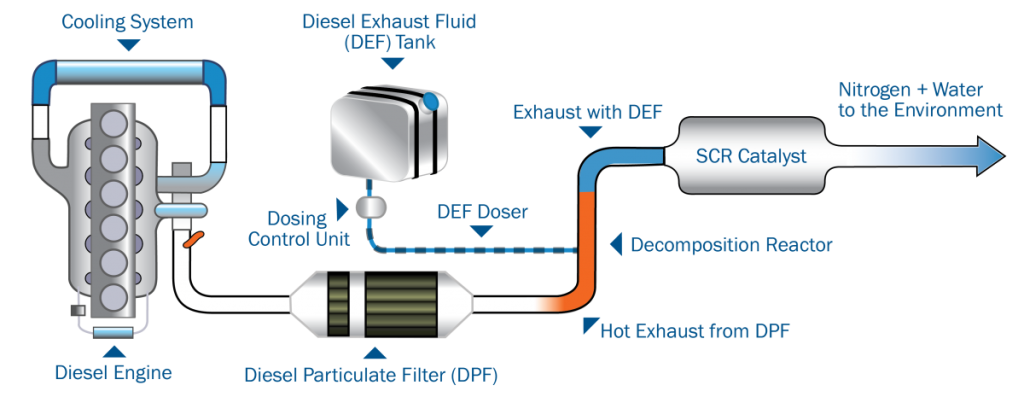
This DPF and DEF system maintenance guide covers best practices, common mistakes, and how to avoid costly repairs.
Brought to you by Richard Kemner | RDK Truck Sales
| THE 5 MOST COSTLY MISTAKES |
| 1. Putting diesel fuel in the DEF tank → $8,000 – $15,000 system replacement 2. Using non-dedicated funnels or containers → Permanent catalyst poisoning ($3,000 – $5,000) 3. Using old, heat-damaged, or diluted DEF → Injector failure, crystalline deposits ($1,500 – $3,000) 4. Interrupting DPF regeneration cycles → Excessive soot loading, forced regen, potential DPF damage ($2,000 – $8,000) 5. Ignoring warning lights and fault codes → Small problems become complete system failures |
Quick Reference: Do’s and Don’ts
| DO THIS | NEVER DO THIS |
| Use only API-certified DEF | Put any other fluid in DEF tank |
| Use dedicated blue DEF equipment only | Use funnels/containers that held other fluids |
| Store DEF in cool location (50-77°F ideal) | Store DEF in direct sunlight or above 86°F |
| Clean filler area before opening DEF cap | Leave DEF cap off or fill in dusty conditions |
| Allow DPF regeneration to complete | Shut off engine during active regeneration |
| Use CK-4 or FA-4 low-ash engine oil | Use high-ash oil (accelerates DPF clogging) |
| Address warning lights immediately | Ignore fault codes or “wait and see” |
Section 1: How to Fill a DEF Tank Properly
| ⚠ WHAT GOES WRONG: • Cross-contamination: Using equipment that touched fuel or oil introduces contaminants that poison the SCR catalyst permanently • Dirt and debris: Particles enter through dirty fill areas, clogging the DEF filter and pump • Misfueling: Even a small amount of diesel in the DEF tank destroys the entire SCR system |
Required: Clean Filling Procedure
- Clean the area around the DEF cap with a lint-free cloth before opening
- Use only dedicated DEF equipment (blue funnels, containers, nozzles) – never equipment that held other fluids
- Verify DEF is API-certified and check the date – don’t use expired product
- Fill slowly to prevent splashing – do not overfill
- Replace cap immediately after filling – never leave it open
- Clean up any spills with water immediately (DEF crystallizes on surfaces)
Equipment Requirements
- Containers: Stainless steel or HDPE plastic only – dedicated to DEF
- Funnels: Blue color-coded, never used for anything else
- Storage: Keep filling equipment covered and clean between uses
- Incompatible materials: Copper, brass, zinc, galvanized metal, aluminum, carbon steel – contact with these contaminates DEF
Section 2: How to Store DEF Properly for to Reduce Degradation
| ⚠ WHAT GOES WRONG: • Heat degradation: DEF stored above 86°F breaks down, forms crystalline deposits in the injector and catalyst • Wrong concentration: DIY mixing or water dilution causes improper NOx conversion, triggering fault codes and derating • Metal contamination: Trace metals from improper containers permanently poison the catalyst – cannot be reversed |
DEF Specification Requirements
Only use DEF that is API-certified and meets ISO 22241 standards:
| Parameter | Requirement |
| Urea Concentration | 32.5% ± 0.7% (CRITICAL) |
| Water Quality | Deionized/demineralized only |
| Metals (Ca, Fe, Cu, Zn) | < 0.5 ppm total |
| Phosphates | < 0.5 ppm (trace amounts kill catalyst) |
Storage Temperature Impact
| Temperature | Shelf Life | Action |
| 50-77°F (10-25°C) | 24+ months | IDEAL |
| 77-86°F (25-30°C) | ~12 months | Acceptable |
| 86-95°F (30-35°C) | ~6 months | Use quickly |
| Above 95°F (35°C) | Rapid breakdown | DO NOT USE |
Storage Best Practices
- Store indoors in a cool, dry, well-ventilated area away from direct sunlight
- Keep containers sealed – ammonia evaporates from exposed DEF
- Practice FIFO (First In, First Out) – mark containers with purchase dates
- Never mix DEF from different suppliers or batches
Section 3: Proper DPF Maintenance Required
| ⚠ WHAT GOES WRONG: • Interrupted regeneration: Shutting off the engine during active regen prevents soot burnoff, leading to excessive loading and forced parked regen • Excessive idling: Low exhaust temps produce soot but can’t burn it off – rapid DPF loading • Wrong engine oil: High-ash oils leave incombustible deposits that regeneration cannot remove • Ignored warning lights: Continued operation with high soot loading can cause thermal damage to the DPF substrate |
Understanding Regeneration
The DPF collects soot and must periodically burn it off. There are three types of regeneration:
| Type | When It Happens | What To Do |
| Passive | Automatically during highway driving (high exhaust temps) | No action needed – happens naturally |
| Active | ECM injects extra fuel when passive isn’t enough (light may illuminate) | Keep driving until complete – don’t shut off |
| Parked/Forced | Required when DPF is severely loaded | Must perform immediately to prevent damage |
Operational Best Practices
- Allow regeneration to complete: When the DPF indicator shows active regen, maintain steady driving (if safe) until it finishes
- Schedule highway time: Vehicles with mostly short-trip, stop-and-go operation need periodic highway driving for passive regen
- Minimize idle time: Excessive idling produces soot without the heat to burn it off – use APU when stationary
- Use correct engine oil: CK-4 or FA-4 rated low-ash oils ONLY – high-ash oils clog the DPF with incombustible ash Read this article for more information.
- Fix engine problems promptly: Oil leaks, bad injectors, turbo issues dump extra soot or oil into the DPF
- Use ULSD fuel only: High-sulfur fuel damages the DPF and DOC catalyst
Warning Signs of DPF Problems
- DPF warning light or check engine light illuminated
- Reduced engine power or limp mode
- Frequent regeneration attempts
- Increased fuel consumption
- If any of these occur – address immediately to prevent costly damage
Service Intervals
| Service | Interval |
| Back pressure monitoring | Every PM / continuous |
| DPF inspection | Annually or every 100,000 miles |
| Professional ash cleaning | 150,000 – 300,000 miles (varies by duty cycle) |
Section 4: How Small Problems Become Big Repairs
Poor DEF quality and improper DPF maintenance create a cascade of failures. Understanding this chain helps explain why prevention is so important.
| Initial Problem | What Fails Next | Final Cost |
| Contaminated DEF | DEF pump → Injector → SCR catalyst → NOx sensors | $3,000 – $8,000 |
| Fuel in DEF tank | Destroys entire SCR system simultaneously | $8,000 – $15,000+ |
| Heat-degraded DEF | Crystalline deposits → Injector clog → Poor dosing → Catalyst deposits | $1,500 – $5,000 |
| Ignored regen cycles | Excessive soot → Forced regen → Thermal damage to DPF | $2,000 – $8,000 |
| Wrong engine oil | Ash buildup → Reduced DPF capacity → Premature cleaning/replacement | $500 – $3,000 |
The Bottom Line
| PREVENTION COST Quality DEF: ~$3/gallon Dedicated equipment: ~$50 one-time Proper storage: Minimal Training: Time only | FAILURE COST DEF injector: $800 – $1,500 DEF pump: $1,000 – $2,000 SCR catalyst: $2,000 – $5,000 DPF replacement: $3,000 – $8,000 + Downtime |
Section 5: Maintenance Checklists
Daily (Driver Responsibility)
- Check DEF level – top off using clean filling procedures
- Monitor dashboard for DPF or DEF warning lights
- Allow regeneration cycles to complete – don’t shut off during active regen
- Report any unusual exhaust smoke or odors
Weekly (Shop/Fleet Manager)
- Verify DEF inventory is properly stored (cool, sealed, in date)
- Inspect DEF filling equipment for cleanliness
- Review any logged fault codes across fleet
Each PM Service
- Check exhaust back pressure readings
- Inspect DEF tank cap and seal condition
- Inspect DEF lines and connections for crystalline deposits
- Check for DEF leaks
- Review and document any stored fault codes
- Verify correct engine oil is being used (CK-4/FA-4)
Annual
- Professional DPF inspection – evaluate cleaning need
- DEF system component inspection
- NOx sensor testing
- Audit DEF storage and handling procedures
- Driver/technician refresher training on proper procedures
| REMEMBER: THE 3 KEYS TO SYSTEM LONGEVITY |
| 1. QUALITY DEF – API certified, properly stored, never contaminated 2. CLEAN FILLING – Dedicated equipment, clean procedures, every time 3. COMPLETE REGENERATION – Let the DPF do its job, don’t interrupt |
Additional Resources
For more information on DEF and DPF system requirements, refer to these official sources: Thank you for reading our DPF and DEF System Maintenance Guide.
- EPA Diesel Exhaust Fluid Guidelines – Official EPA guidance on DEF systems and regulations
- API Diesel Exhaust Fluid Certification Program – Find API-certified DEF products that meet ISO 22241 standards
- API Engine Oil Categories – CK-4 and FA-4 oil specifications for diesel engines
This DPF and DEF System Maintenance Guide is provided for educational purposes. Always consult your vehicle manufacturer’s specific recommendations.
Questions? Contact RDK Truck Sales – Your Trusted Partner in Refuse Equipment Since 1997
Tampa, Florida | www.rdk.com